How Long Before a Phone Number Is Reused? Aging Rules, Recycling Data and What It Means for Your Codes
The short answer
- In the US a disconnected number must be aged at least 45 days before it's reassigned, and at most 90 days for a home line or 365 days for a business line.[2]
- The FCC estimated that about 35 million US numbers are disconnected and made available for reassignment each year.[1]
- The UK has no regulator-set wait; Ofcom says operators decide, and it could be anywhere from 3 months up to a year.[8] Australia's standard quarantine is six months.[9]
- Recycled numbers still receive old owners' codes: in a Princeton test, 19 of 200 honeypot lines (about 10%) got sensitive messages within a week,[13] and 6 still got login codes.[7]
- Move your accounts, especially recovery settings, before your old number's wait runs out.
Short version: in the US, a carrier has to wait at least 45 days after a number is permanently disconnected before it can give that number to someone new, and it can't hold a residential number back for more than 90 days.[2] Business numbers can be held for up to 365 days.[2] The UK has no regulator-set wait at all: Ofcom says operators decide, and the gap could be anywhere from 3 months to a year.[8] Australia's industry code sets a standard six-month quarantine.[9] After that, your old number belongs to a stranger, and so does every code still sent to it.
I'm Serhat, and I built TwoLine, which sells one-time numbers for a single SMS code. This topic matters to me because a phone number is the key a lot of apps use to decide who you are, and recycling hands that key to someone else on a schedule. Below you'll find the rules by country, the official counts, what Princeton researchers found when they looked at numbers carriers were offering to new customers, and a checklist for changing your number without leaving accounts behind.
How long before a phone number is reused in the US?
The FCC calls the waiting period "aging". An aging number is a disconnected number that a carrier isn't allowed to give to another customer for a set time. The rule sits in 47 CFR 52.15, and it has both a floor and a ceiling: at least 45 days for every number, at most 90 days for a number that belonged to a residential customer, and at most 365 days for a business number.[2]
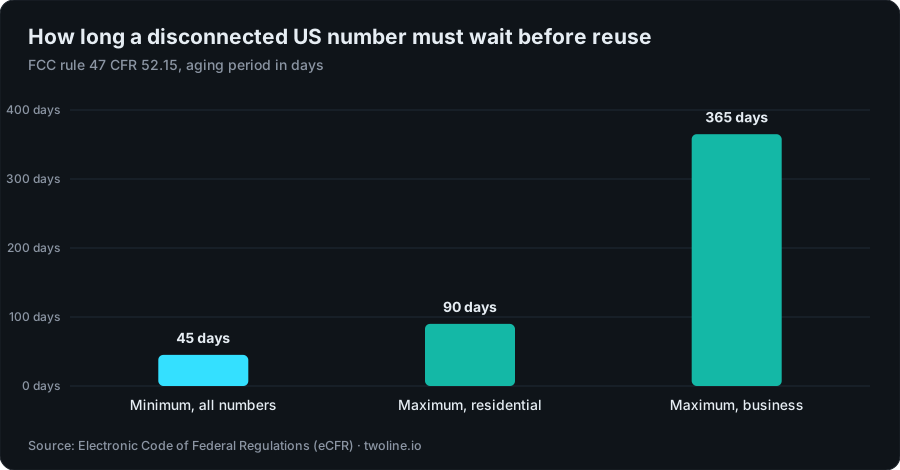
Chart data
| Rule | Days |
|---|---|
| Minimum, all numbers | 45 days |
| Maximum, residential | 90 days |
| Maximum, business | 365 days |
The floor is the newer half. Before the FCC's December 2018 robocall order, its rules only capped how long a carrier could hold a number, so a number used by one person today could go to another person almost immediately.[1] The FCC picked 45 days so that each month's disconnections would reach its new database before any of those numbers were handed out again, with a buffer on top.[1]
How many numbers go through this? The FCC's own estimate, made when it wrote the 45-day rule, was that roughly 35 million US numbers are disconnected and made available for reassignment every year.[1] That's close to 96,000 a day. Not all of them are mobile numbers, and not all of them go straight back out, but it's a huge pool, and every number in it has a history.
What the rule doesn't tell you is the exact day your old number goes back on sale. Anywhere between day 45 and day 90 is fair game for a residential line, and that choice is the carrier's. Carriers haven't always been clear about it either: when the Princeton researchers asked T-Mobile and Verizon about their recycling policies, they got inconsistent answers.[4] The figures carriers gave reporters differed too. In 2017, before the 45-day floor existed, T-Mobile told ABC11 it could recycle a number 60 days after disconnection, or after 30 days in big cities.[14] Verizon said it retired numbers for at least 50 days,[15] and AT&T said about 60.[16] None of them may go under 45 days now.[2]
The FCC Reassigned Numbers Database, explained
The Reassigned Numbers Database, or RND, is the FCC's record of US phone numbers that have been permanently disconnected, along with the date each one was last disconnected.[3] Every provider that gets US numbers from the national numbering administrator has to report its permanent disconnections each month, and it has to age a number for at least 45 days before reassigning it.[3] When I read the RND's FAQ on November 2, 2026, it said the database held over 361 million geographic and toll-free numbers, a total that grows every month.[3]
Who's it for? Not really for you and me. It's a prepaid subscription service for callers: businesses, schools, clinics and anyone else who calls or texts customers and wants to know whether a number has changed hands since the customer gave it to them.[3] The FCC built it to cut unwanted calls to people who inherit a number, and it gives callers who check it a legal safe harbor if the database gets an answer wrong.[1]
Two details matter if you're the one changing numbers. A temporary suspension, say for an unpaid bill, isn't a permanent disconnection, so the number doesn't land in the database. And porting your number to another carrier isn't a disconnection either, because the number stays yours.[3] That second point is your best tool, and I'll come back to it in the checklist.
What the database can't do is protect your accounts. It only helps if the sender looks the number up before sending. Whether a given app or bank checks it before texting a login code isn't something most of them publish, so I wouldn't count on it.
Phone number recycling in the UK, Australia, India and on app numbers
Phone number recycling is the practice of giving a disconnected number to a new subscriber after a waiting period. Every country does it, because there are only so many numbers in each range. What changes from place to place is how long the wait is and who decides it.
The UK is the loosest of the four countries here. In a 2021 reply to a member of the public, Ofcom said it doesn't set the timescale: each operator decides when a number goes back into the pool, and the gap could be anywhere from 3 months up to a year.[8] Pay-as-you-go numbers carry an extra trap. Contract terms usually require a chargeable action, such as a call, a text or a top-up, within a set period, and providers can suspend and recycle numbers that miss it.[8] The person Ofcom was answering had kept an unused PAYG number just for two-factor codes, which is exactly the kind of quiet line that gets recycled without anyone noticing.
Australia's rule comes from an industry code registered with the regulator, the ACMA. Under code C566:2023, a disconnected number goes into quarantine, and the standard quarantine period is six months.[9] If the line was disconnected because of unwelcome or life-threatening communications, the number must stay in quarantine for at least 12 months.[12]
In India, the telecom regulator TRAI told the Supreme Court in 2023 that a mobile number deactivated for non-use, or disconnected at the subscriber's request, isn't allocated to a new subscriber for at least 90 days.[11] The court's response is worth noticing: it said it's for the earlier subscriber to take steps to protect their privacy, such as deleting the WhatsApp account tied to the old number.[11]
Google Voice and app numbers
Numbers that live inside an app follow the app's rules, not a regulator's aging period, and those rules turn on whether you use the number. Google's Voice Acceptable Use Policy says Google may reclaim a Voice number if you don't appear to be using the service, such as placing calls or sending texts, for 3 months.[17] After the reclaim date, you have 45 days to get the number back.[18] TextNow says there's no hard-and-fast rule for how long a number can stay inactive before it's revoked,[19] and once a number has been released, you'd need to choose a new one.[20] If an app number is the one on your accounts, an unused month or two can cost you more than you'd think.
| Where | Who sets the wait | How long before a number is reused |
|---|---|---|
| United States | FCC rule, 47 CFR 52.15 | At least 45 days; at most 90 days for residential and 365 days for business numbers[2] |
| United States | FCC Reassigned Numbers Database | Carriers report permanent disconnections monthly and age each number at least 45 days[3] |
| United Kingdom | Each operator; Ofcom sets no period | Could be anywhere from 3 months up to a year (Ofcom, 2021)[8] |
| Australia | Industry code C566:2023, registered with the ACMA | Standard quarantine of six months[9]; at least 12 months after disconnections over unwelcome or life-threatening communications[12] |
| India | TRAI, as told to the Supreme Court in 2023 | At least 90 days[11] |
| Google Voice | May be reclaimed after 3 months without use[17]; 45 days after the reclaim date to get it back[18] | |
| TextNow | TextNow | No fixed inactivity period[19]; a released number can't be restored[20] |
| Old account data removed after 45 days of inactivity and activation on a new device[10] |
Notice what's missing from every row. None of these rules notifies the companies that send codes to the old number; the US database only helps a sender who checks it. The rest is left to you.
What happens to your phone number when you cancel
The usual path for a US number looks like this:
- You cancel, or the carrier ends the service. If it's permanent, meaning not a pause for a missed payment and not a port to another carrier, the number counts as permanently disconnected.[3]
- The number starts aging. It can't go to anyone else for at least 45 days.[2] People who call it may hear an intercept message saying the number isn't in service.[1]
- It's reported to the Reassigned Numbers Database in the carrier's next monthly report.[3]
- It goes back into the carrier's stock. Somewhere between day 45 and day 90 for a residential line, the carrier can offer it to a new customer.[2]
- Someone new picks it. From then on, every text and call to that number reaches them, login codes and password resets included.
Can you get it back? While the number is still aging, sometimes, but you'll have to ask your old carrier, and it's their call. Ofcom says the same for the UK: reactivating a number during the suspension period may be possible, but you'd need to check with the provider.[8] Once it's been handed to someone else, it's gone.
The cleaner move is not to cancel at all. If you're switching carriers, port the number. If you're giving up a line but still have accounts tied to it, keep it alive on the cheapest plan you can find while you move those accounts. The Princeton researchers recommend exactly this: park your number when you disconnect a line rather than letting it go back into the pool.[5]
What researchers found about reassigned phone numbers
The best public data on this comes from Kevin Lee and Arvind Narayanan at Princeton. Their study, presented at the APWG eCrime symposium in 2021, looked at numbers that T-Mobile and Verizon were offering to new subscribers through their online number change pages.[4] They sampled 259 of those numbers and found that 215 had been recycled and were open to account hijacking or to exposing the previous owner's personal details.[6] That's more than four in five.
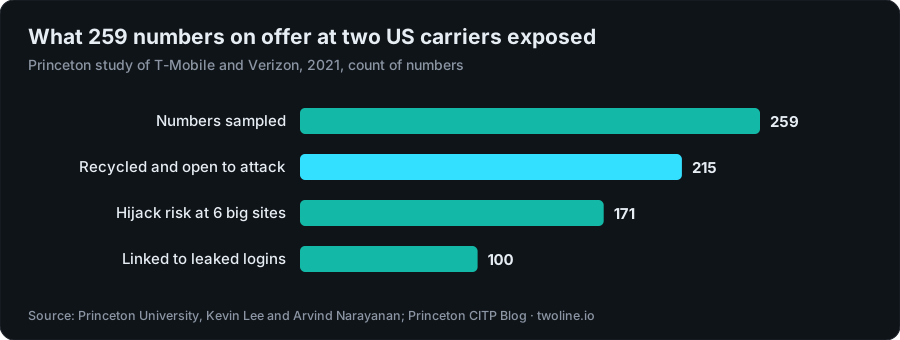
Chart data
| Finding | Numbers |
|---|---|
| Numbers sampled | 259 |
| Recycled and open to attack | 215 |
| Hijack risk at 6 big sites | 171 |
| Linked to leaked logins | 100 |
The account figures are the ones that should worry you. 171 of the 259 numbers were open to account hijacking at six big sites, Amazon, AOL, Facebook, Google, PayPal and Yahoo, because each was still tied to an account at one of them.[4] And 100 of the 259 were linked to login credentials that had already leaked online, which the authors say could let an attacker get past SMS-based multi-factor authentication.[5] Put plainly: the password was already out there, and the second factor was a text to a number someone else could now own.
Then they looked at it from the receiving end. They took a set of recycled numbers for one week and watched what arrived. 19 of the 200 numbers in that honeypot, about 10%, received sensitive calls or texts meant for previous owners,[13] and 6 lines were still getting authentication codes.[7] Nobody had to do anything clever. The codes just showed up.
The researchers also describe a nastier case: someone who learns that a person they know has changed numbers can watch the aging period and try to pick up the old number once it's released.[4] So the wait isn't really a safety window for you. It's a countdown.
Did the carriers fix it? After the researchers disclosed their findings, both carriers updated their support pages to remind people to update or unlink their accounts before changing numbers, and to state the FCC aging period.[4] Better paperwork, then. It doesn't change how recycling works.
| Figure | What it measures |
|---|---|
| 35 million a year[1] | US numbers disconnected and made available for reassignment (FCC estimate, 2018) |
| Over 361 million[3] | Numbers logged as permanently disconnected in the FCC's Reassigned Numbers Database |
| 215 of 259[6] | Numbers on offer at two US carriers that were recycled and open to attack |
| 171 of 259[4] | The same sample, open to hijacking at one of six big websites |
| 100 of 259[5] | The same sample, linked to leaked login credentials |
| 19 of 200 honeypot lines, about 10%[13] | Recycled lines that got sensitive calls or texts for previous owners within a week; 6 still got login codes[7] |
Recycled phone number verification codes and account recovery
An SMS verification code is a short one-time password that a service texts to the number on file to prove you control it. The catch is in that last bit. It proves control of the number, not that you're the person who signed up, so when the number changes hands, the proof goes with it. I go through the mechanics in how SMS OTP works.
Recycling causes trouble in two directions:
- Your old number gets your codes. If an account still lists the old number for login or recovery, the new owner can receive its codes, by accident or on purpose. The Princeton honeypot showed exactly this: login codes kept arriving for people who'd moved on.[7]
- Your new number gets someone else's. If you're given a recycled number, expect texts and codes for the last owner. Don't use them. If an app says your new number is already registered, that's the previous owner's account, and the app's own help pages are the right route to sort it out.
Some apps try to clean up for you. India's Supreme Court, citing WhatsApp's help center, noted that WhatsApp monitors account inactivity because of recycled numbers: when an account has been inactive for 45 days and is then activated on a different device, the old account data is removed.[10] That helps with chat history. It doesn't help with your email, your cloud storage or anything else that resets by text.
SIM swap fraud and recycling are cousins. Both put your codes in someone else's hands, one by crime and one by routine. If you want the fraud side, I've covered it in is SMS 2FA safe. The fix is the same for both: wherever an account offers an authenticator app or a passkey, use it, and keep SMS as a backup on a number you actually control.
Checklist: before you change or cancel a number
- List what uses the number. Email, your Apple or Google account, bank, mobile wallet, social apps, messaging apps, your doctor, your kids' school.
- Add the new number first, then remove the old one. Do it while the old SIM still works, because some services ask for a code on the old number before they'll accept the change.
- Move two-factor off SMS where you can. An authenticator app or a passkey doesn't care what happens to your number.
- Update recovery details, not just login details. Account recovery is the route the Princeton team showed attackers could use on recycled numbers.[4]
- Use each messaging app's own change-number feature instead of simply registering on the new number, so your contacts and history move with you.
- Port instead of cancelling if you can, or keep the old line on a cheap plan for a few months. In the UK, make sure a PAYG line gets a chargeable use often enough that it isn't recycled.[8] On Google Voice, make a call or send a text before the reclaim date.[17]
- Tell the people who contact you. Banks, clinics, employers, schools. The FCC built its database partly because people who drop a number don't always update everyone who used to contact them.[1]
- Set a deadline. In the US, your old number could belong to someone else 45 days after it's disconnected.[2] Put that date in your calendar and finish the list before it.
Just got a new number? Assume it's recycled. Ignore codes you didn't ask for, don't tap links in texts meant for the old owner, and if a company keeps contacting you for someone else, tell it the number has been reassigned.
Why apps care about a number's history, and where one-time numbers fit
Everything above is why apps treat phone numbers with some suspicion. An app knows when a number was last verified with it, whether it's tied to another account and how often it's turned up in signups. From its side, a number with a history might be a recycled line, someone's old account or a number passed around for bulk signups, so some apps refuse numbers that were used before. It's one of the main reasons verification fails, and I've written about it in why free phone number apps fail verification. For keeping your own number off sign-ups in general, see private phone number for online accounts.
TwoLine works on one number for one code, and that has a catch here. From the app's point of view, a one-time number is a reused number too. You get it for one SMS code, usually for 10 to 20 minutes and sometimes less, and when that window closes it's no longer yours. That makes it reasonable for a throwaway signup you'll never need to recover, and wrong for any account you'd be upset to lose, because that account's recovery codes would go to a number you don't control. It's the recycling problem again, only this time you'd be choosing it.
The limits:
- One number gets one code. There's no rental and no second code later (one-code vs rental numbers).
- The app you're verifying decides whether it accepts a number.
- No numbers for banks, payment apps, money transfer, crypto exchanges, securities accounts or government identity services.
- If no code arrives in the window, the full price goes back to your TwoLine balance, not your card. The refund policy has the details.
Prices are live and change, and the pricing page shows today's. Before you use any outside number for a code, run through the OTP number risk checklist, and if you want the case for single-use numbers in more depth, read one-time phone numbers for verification.
How I checked these numbers
I read every source on November 2, 2026, and each outside figure here links to a page I opened. A few caveats, so you can weigh them. The 35 million figure is the FCC's 2018 estimate, and I couldn't find a newer official count of yearly disconnections.[1] The Princeton figures come from two US carriers in 2020 and 2021, and those carriers have updated their help pages since. The 2017 carrier figures are a reporter's summary of what each carrier said, and they predate the 45-day floor. The UK range comes from a 2021 Ofcom letter rather than a rule, so a given operator may work differently today.[8] The Australian figures come from the industry code itself rather than the ACMA's consumer page.[9] Know of a newer official number? I'd like to see it.
Keep your real number off sign-ups you won't keep
Every account tied to your number is one more to move when you change it. For a one-off signup, pick the app and country, see the live price first, and get one number for one SMS code. The app decides whether it accepts the number. If no code arrives in the window, the full price returns to your TwoLine balance.
See live numbersFAQ
How long before a phone number is reused in the US?
At least 45 days. FCC rules say a disconnected number must be aged for no less than 45 days, and no more than 90 days if it belonged to a residential customer or 365 days if it belonged to a business.[2] Within that window, the carrier picks the day it goes back on offer.
How long before a phone number is reassigned in the UK?
There's no fixed period. Ofcom has said the timescale is a commercial decision for each operator and could be anywhere from 3 months up to a year.[8] Pay-as-you-go numbers can also be suspended and recycled if you don't make a chargeable call, text or top-up within the operator's set period.[8]
What happens to your phone number when you cancel?
In the US it's treated as permanently disconnected, reported to the FCC's Reassigned Numbers Database and aged for at least 45 days before the carrier can give it to someone else.[3] A temporary suspension for an unpaid bill or a port to another carrier doesn't count, because the number stays yours.[3] If you still need it, ask your old carrier while it's aging, or port it instead of cancelling.
What is the FCC Reassigned Numbers Database?
It's a database of US numbers that have been permanently disconnected, with the date of each number's most recent disconnection, fed by monthly reports from every provider.[3] Businesses and other callers pay to check it so they don't call or text someone who inherited a number. Its FAQ says it holds over 361 million geographic and toll-free numbers.[3]
Can a recycled phone number receive my verification codes?
Yes, if an account still lists that number. Princeton researchers who watched recycled lines for a week found 19 of 200 honeypot lines, about 10%, receiving sensitive communication meant for previous owners,[13] and 6 still receiving authentication codes.[7] Update login and recovery numbers before you give up a number, and switch to an authenticator app or passkey where you can.
How can I tell if my new number was recycled?
Assume it was. Texts or codes meant for someone else are the usual sign. The FCC's Reassigned Numbers Database is a paid service for callers, not a lookup for subscribers.[3] Ignore codes you didn't request, and tell any company that keeps contacting you for the previous owner that the number has been reassigned.
About this article
Written by Serhat Doğan, founder of TwoLine. He's a London-based software developer who has built SMS verification tools full-time since early 2026. Disclosure: I built TwoLine, which sells one-time numbers for a single SMS code, so I have a stake in this topic. Every outside number in this guide links to its source below. TwoLine doesn't publish delivery measurements of its own, and no app promises to accept any number, ours included.
Find me on GitHub, LinkedIn and X. Read the refund policy, privacy policy and terms, or contact support.
Sources
- Federal Communications Commission, “Advanced Methods to Target and Eliminate Unlawful Robocalls, Second Report and Order (FCC 18-177)”, 2018-12-13. docs.fcc.gov/public/attachments/FCC-18-177A1.pdf (accessed 2026-11-02)
- Electronic Code of Federal Regulations (eCFR), “47 CFR 52.15, Central office code administration (up to date as of 10/29/2026)”. www.ecfr.gov/current/title-47/chapter-I/subchapter-B/part-52/subpart-B/section-52.15 (accessed 2026-11-02)
- Reassigned Numbers Database (FCC), “Frequently Asked Questions”. www.reassigned.us/resources/faq (accessed 2026-11-02)
- Princeton University, Kevin Lee and Arvind Narayanan, “Security and Privacy Risks of Number Recycling at Mobile Carriers in the United States (project page)”, 2022-01-27. recyclednumbers.cs.princeton.edu (accessed 2026-11-02)
- Princeton University, Kevin Lee and Arvind Narayanan, “Security and Privacy Risks of Number Recycling at Mobile Carriers in the United States (paper, APWG eCrime 2021)”, 2021. recyclednumbers.cs.princeton.edu/assets/recycled-numbers-latest.pdf (accessed 2026-11-02)
- Princeton CITP Blog, “Phone number recycling creates serious security and privacy risks to millions of people”, 2021-05-03. blog.citp.princeton.edu/2021/05/03/phone-number-recycling-creates-serious-security-and-privacy-risks-to-millions-of-people (accessed 2026-11-02)
- Princeton University, Kevin Lee, “Security and Privacy Risks of Number Recycling at Mobile Carriers in the United States (eCrime 2021 slides)”, 2021. recyclednumbers.cs.princeton.edu/assets/ecrime2021-lee-slides.pdf (accessed 2026-11-02)
- Ofcom, “Freedom of Information request: mobile number recycling (reference 01280276)”, 2021-07-01. www.ofcom.org.uk/siteassets/resources/documents/about-ofcom/foi/2021/july/ee-mobile-number-recycling-published.pdf (accessed 2026-11-02)
- Communications Alliance (registered with the ACMA), “C566:2023 Number Management – Use of Numbers by Customers Industry Code”, 2023-05. www.commsalliance.com.au/wp-content/uploads/2025/06/C566_2023.pdf (accessed 2026-11-02)
- Supreme Court of India, “Rajeswari v. Union of India, Writ Petition (Civil) No. 699/2021, order (WhatsApp help center, as cited)”, 2023-10-30. api.sci.gov.in/supremecourt/2021/13468/13468_2021_3_45_47839_Judgement_30-Oct-2023.pdf (accessed 2026-11-02)
- Supreme Court of India, “Rajeswari v. Union of India, Writ Petition (Civil) No. 699/2021, order (TRAI affidavit)”, 2023-10-30. api.sci.gov.in/supremecourt/2021/13468/13468_2021_3_45_47839_Judgement_30-Oct-2023.pdf (accessed 2026-11-02)
- Communications Alliance (registered with the ACMA), “C566:2023 Number Management – Use of Numbers by Customers Industry Code (clause 7.2.1)”, 2023-05. www.commsalliance.com.au/wp-content/uploads/2025/06/C566_2023.pdf (accessed 2026-11-02)
- Princeton CITP Blog, “Phone number recycling creates serious security and privacy risks to millions of people (honeypot results)”, 2021-05-03. blog.citp.princeton.edu/2021/05/03/phone-number-recycling-creates-serious-security-and-privacy-risks-to-millions-of-people (accessed 2026-11-02)
- ABC11 (WTVD), “New cell phone causes 13-year-old to get text messages meant for escort (T-Mobile)”, 2017-11-02. abc11.com/post/new-cell-causes-teen-to-get-texts-meant-for-escort/2596548 (accessed 2026-11-02)
- ABC11 (WTVD), “New cell phone causes 13-year-old to get text messages meant for escort (Verizon)”, 2017-11-02. abc11.com/post/new-cell-causes-teen-to-get-texts-meant-for-escort/2596548 (accessed 2026-11-02)
- ABC11 (WTVD), “New cell phone causes 13-year-old to get text messages meant for escort (AT&T)”, 2017-11-02. abc11.com/post/new-cell-causes-teen-to-get-texts-meant-for-escort/2596548 (accessed 2026-11-02)
- Google Voice Help, “Voice Acceptable Use Policy”. support.google.com/voice/answer/9230450?hl=en (accessed 2026-11-02)
- Google Voice Help, “Reclaim your Voice number”. support.google.com/voice/answer/159519?hl=en (accessed 2026-11-02)
- TextNow Support, “Help! My Phone Number was recycled, how can I get it back? (inactivity)”. supportfree.textnow.com/hc/en-us/articles/204253309-Help-My-Phone-Number-was-recycled-how-can-I-get-it-back (accessed 2026-11-02)
- TextNow Support, “Help! My Phone Number was recycled, how can I get it back? (restoring a number)”. supportfree.textnow.com/hc/en-us/articles/204253309-Help-My-Phone-Number-was-recycled-how-can-I-get-it-back (accessed 2026-11-02)