Virtual Number for OTP in 2026: Free vs Paid, Picking a Country, and Real Prices
The short answer
- A virtual number for OTP is a phone number that isn't on your own SIM, used to receive a one-time code. Free public ones show your code to anyone; paid private ones don't.
- Pick the country you live in or the account is for. The country changes price, stock and line types, not the app's rules.
- As of November 2, 2026, TwoLine's cheapest Telegram line ran from $0.39 (Indonesia, Canada) to $1.85 (Germany, Netherlands), while Google, Instagram and TikTok were $0.39 almost everywhere. Prices are live, and the app still decides.
- No seller can promise an app accepts a number, and a one-time number can't get later codes, so keep accounts you must recover on your own SIM.
A virtual number for OTP is a phone number that isn't on a SIM in your own phone, used to receive a one-time code by SMS. You pick the app, pick a country, get the number, request the code and read it on a web page. There are two kinds: free shared numbers that anyone can read, and paid private numbers that only you see. Neither comes with a promise that the app will accept it. The app decides. I built TwoLine, which sells the private, one-code kind, so read the rest with that in mind.
Below I'll cover how the two kinds differ, how to choose a country (for most apps it barely moves the price; for a messaging app like Telegram it moves it a lot), a price table for 11 countries and 6 apps from TwoLine's catalog as of November 2, 2026, what regulators in India, Nigeria, the UK and the US say about why apps there lean on SMS, and why WhatsApp is a special case.
What a virtual number for OTP actually is
Two terms first. An OTP (one-time password) is a short code an app sends to prove you can receive messages on a number right now. A virtual number is a phone number you use without having its SIM in your own phone; its messages show up on a web page or in an app instead (the wider category is in the virtual phone number guide).
Put them together and a virtual number for OTP is a number you use so a code lands somewhere other than your personal SIM. The reasons are usually ordinary. You don't want to hand your real number to a new app, you're testing something, your own SIM is switched off abroad, or you just want a signup kept apart from your phone. If you want the mechanics of how the code travels, I've written them up in how SMS OTP works.
OTP codes are short-lived on purpose. NIST's 2025 authentication guidelines, written for US government systems, say a code sent out of band has to be used within 10 minutes or it's invalid[7]. Apps set their own windows, but the idea's the same everywhere: the number only has to work for a few minutes. That short window is what makes a one-time number workable.
The same NIST document tells verifiers to weigh risk signals such as a SIM change or number porting before sending a code over the phone network[12]. Its 2025 revision also removed an older ban on VoIP numbers for this kind of check[11]. So the standards body no longer rules VoIP out, yet plenty of apps still look at what kind of line a number is and turn some types away. That's the app's call, not the number seller's.
Free virtual number for OTP vs a private one
Search for a free virtual number for OTP and you'll find two different things. One is a public inbox website: it lists a handful of numbers, and every SMS sent to them appears on a page anyone can open. The other is a free second-number app that gives you a number to keep inside that app.
The public inbox is the one to be careful with. A shared number is a number that many strangers use at the same time, so every code on it is public. In 2016, researchers at the University of Florida tracked over 400 public gateway numbers in 28 countries for 14 months and collected 386,327 messages[8]. Among them they found services sending extremely sensitive data in plain text and one-use codes that were easy to guess[13]. The study is ten years old, but the model hasn't changed: if you can read a stranger's code, a stranger can read yours.
There's a practical problem too. Apps cap how often one number can be used. Google's help page says it limits the number of accounts each phone number can create[9]. A public number that lots of strangers have already typed in is likely to hit limits like that before you get there. The public inbox vs private number guide goes deeper on the privacy side, and the private receive-SMS page shows the alternative.
A private number is one where, for as long as you hold it, only you can see its messages. Paid numbers work this way, whether they're kept for months as a second line or used once for a single code. The options side by side:
| Question | Free public inbox | Free second-number app | Paid one-time number | Your own SIM |
|---|---|---|---|---|
| Who sees the code | Anyone who opens the page | You | You, on a private order page | You |
| Cost | $0 | $0 to start | A live price per code; on TwoLine the lowest was $0.39 as of November 2, 2026 | Your phone plan |
| Later codes on the same number | Possibly, but in public | Yes, while you keep it | No | Yes |
| Fit for account recovery | No | Only while you keep the number | No | Yes |
| Banks, payments, government ID | No | No | No; TwoLine refuses these | Yes |
How to get a virtual number for OTP, step by step
The steps look much the same wherever you buy. On TwoLine, which I built around one number per code, the flow goes like this:
- Search for the app you're verifying. The app comes first because prices and stock are set per app, not just per country.
- Pick a country and a line. You see the live price before you make an account.
- Pay from your balance. Card top-ups give $5, $10, $25, $50 or $100 of balance for $4.99, $9.99, $24.99, $49.99 or $99.99, and crypto top-ups start at $9.99. Balance isn't cash.
- Copy the number and paste it into the app.
- Request the code in the app. If the app sends one, it appears on your order page.
The number lasts long enough for one code, usually 10 to 20 minutes and sometimes shorter, and the order page shows the exact end time. If no code arrives by then, the full price goes back to your TwoLine balance automatically, and you can also cancel after 2 minutes for the same refund. Once a code's been delivered, the purchase is final. The refund policy has the details, and the one-time number guide covers the model itself.
Virtual number for OTP app: do you need one?
A lot of people search for a "virtual number for OTP app" and expect to install something. You don't have to. What counts is how quickly you can see the code, and that doesn't depend on whether it shows in an app or a browser tab. TwoLine runs in the browser, and the pricing page explains how balance and refunds work. If what you really want is a number that stays yours and keeps getting texts, that's a different product, a kept second line, and a one-time number won't do that job.
How to choose the country for an OTP number
The country choice changes some things and leaves others alone, and it helps to know which is which before you pick.
Match the app's region and your own
The safest default is the country you live in, or the one the account is meant for: a UK account on a UK number, a US account on a US number. The country code becomes part of the account. Contacts may see it, the app may use it to work out your region, and it'll come up again if you ever need support. Picking a far-off country to save a few cents can leave you with an account that looks out of place to the app and to the people you talk to on it.
If you're abroad and only need a code while your own SIM is off, the trade-offs shift. I've covered that case in the travel phone number guide for the US, UK and EU. You can also browse all number countries, or go straight to UK numbers, US numbers or Netherlands numbers.
What changes from country to country
- Price. For Google, Instagram, TikTok, OpenAI and Snapchat, the cheapest line was $0.39 in at least 10 of the 11 countries, as of November 2, 2026. Telegram was the exception, and there the country moved the price a lot.
- How many lines there are. On the same date, the UK had 8 to 10 lines for each of the six apps in the table, while Nigeria and Pakistan had 2 to 4.
- Line types. Lines carry labels such as "Premium · Non-VoIP", "Standard+" and "Virtual". For the apps in the table, Premium · Non-VoIP lines only showed up in the US. The non-VoIP number page explains the term, and a label describes the line; it isn't a way around any app's rules.
- Stock. It moves. A country that's empty now can come back after a restock, and one that's full now can run dry.
Pakistan shows the pattern well. If you're after a Pakistan virtual number for OTP, Telegram lines there started at $1.03 and Snapchat at $0.48 in the snapshot, with 2 or 3 lines per app. The advice is the same as anywhere else: don't put an account you can't afford to lose on a number you don't own.
What the country doesn't change
It doesn't change the app's rules. A number from the "right" country can still be refused, and a cheap country isn't a back door. Don't use the country picker to get around a region lock, an age check, a sanctions rule or an identity check. Those rules exist for legal reasons, and TwoLine isn't built to help anyone dodge them.
Virtual number for OTP prices by country and app
The table shows what TwoLine's public catalog listed when I checked it on November 2, 2026 at 10:19 UTC. Each cell is the cheapest line for that app in that country. Prices are live and change, so treat this as a snapshot, not a quote. I've left WhatsApp out on purpose: its help center asks for an active SIM card in your phone for the number you register[16], and a virtual number isn't in your phone. More on that below.
| Country | Telegram | TikTok | OpenAI | Snapchat | ||
|---|---|---|---|---|---|---|
| United States | $0.93 | $0.46 | $0.39 | $0.39 | $0.39 | $0.39 |
| United Kingdom | $0.65 | $0.39 | $0.39 | $0.39 | $0.39 | $0.39 |
| India | $1.20 | $0.39 | $0.39 | $0.39 | $0.39 | $0.39 |
| Nigeria | $0.59 | $0.39 | $0.39 | $0.39 | $0.39 | $0.39 |
| Pakistan | $1.03 | $0.39 | $0.39 | $0.39 | $0.39 | $0.48 |
| Indonesia | $0.39 | $0.39 | $0.39 | $0.39 | $0.39 | $0.39 |
| Philippines | $0.51 | $0.39 | $0.39 | $0.39 | $0.39 | $0.39 |
| Brazil | $0.74 | $0.39 | $0.39 | $0.39 | $0.39 | $0.39 |
| Germany | $1.85 | $0.39 | $0.39 | $0.39 | $0.39 | $0.39 |
| Netherlands | $1.85 | $0.39 | $0.39 | $0.39 | $0.39 | $0.39 |
| Canada | $0.39 | $0.39 | $0.39 | $0.39 | $0.56 | $0.39 |
A few things stand out. Telegram ran from $0.39 in Indonesia and Canada to $1.85 in Germany and the Netherlands, almost five times as much. Google, Instagram, TikTok, OpenAI and Snapchat sat at the $0.39 floor almost everywhere. In the US, the only country here with Premium · Non-VoIP lines, the cheapest Non-VoIP line was $2.04 for Telegram and $1.22 for Google, against $0.93 and $0.46 for the cheapest line of any type, all as of November 2, 2026. Live countries for single apps are on the Telegram, Google, Instagram and TikTok verification pages.
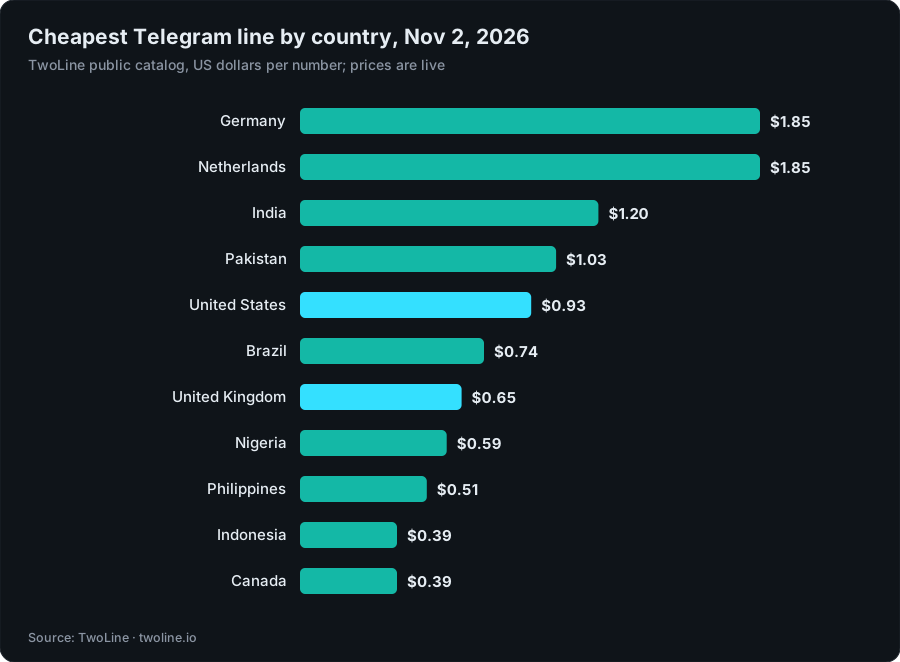
Chart data
| Country | Cheapest Telegram line (USD) |
|---|---|
| Germany | $1.85 |
| Netherlands | $1.85 |
| India | $1.20 |
| Pakistan | $1.03 |
| United States | $0.93 |
| Brazil | $0.74 |
| United Kingdom | $0.65 |
| Nigeria | $0.59 |
| Philippines | $0.51 |
| Indonesia | $0.39 |
| Canada | $0.39 |
What the table tells you, and what it doesn't
It tells you what one code costs today and where there's stock. It doesn't tell you whether the app will accept the number. Price isn't a quality score: a $1.85 line isn't more likely to be accepted than a $0.39 one in any way an app has promised to honour. TwoLine doesn't publish a delivery or success rate, and I won't guess one here. What you do get is the refund rule: if no code arrives in the window, the full price goes back to your balance. The methodology page explains where the catalog's prices and stock come from. For app-by-app detail, see the social media verification guide, the Google verification guide and, for Telegram's own SMS fee screen, the Telegram guide.
Why apps in some countries lean so hard on SMS
A phone-number check works best where a number belongs to one real person. That comes down partly to scale and partly to law, and the regulators' own numbers show both.
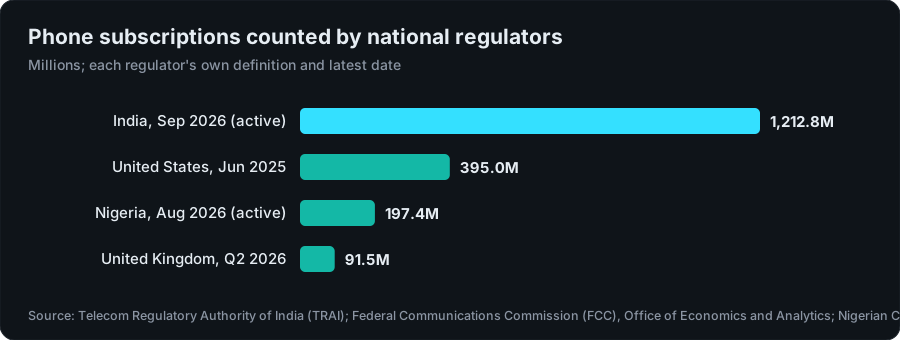
Chart data
| Country and period | Subscriptions (millions) |
|---|---|
| India, Sep 2026 (active) | 1,212.8M |
| United States, Jun 2025 | 395.0M |
| Nigeria, Aug 2026 (active) | 197.4M |
| United Kingdom, Q2 2026 | 91.5M |
Each regulator counts its own way. TRAI's figure is active subscribers on the peak day, the NCC's is active telephone subscriptions, Ofcom leaves out machine-to-machine SIMs, and the FCC counts mobile subscriptions. Read the bars as rough scale, not as a like-for-like ranking.
Virtual number for OTP in India
India is the biggest market in this guide by a long way. TRAI counted 1,212.80 million active wireless subscribers on the peak day in September 2026[1]. Numbers there sit under identity rules that the Department of Telecommunications enforces through its Sanchar Saathi programme. In a March 2025 update, DoT listed 1.19 crore connections, about 11.9 million, disconnected for exceeding the individual limit[14], and 16.97 lakh WhatsApp profiles and accounts, about 1.7 million, disengaged in connection with what it calls shared mobile connections[6].
Messaging apps face a tighter rule on top of that. DoT's SIM-binding directions require apps such as WhatsApp and Telegram to stay continuously linked to the SIM card installed in the device, so the app can't be used without that active SIM[17]. Inc42 reports that the government set December 31, 2026 as the compliance deadline[18]. Once that applies, a messaging account on an Indian number needs the number's SIM in your phone, which a virtual number can't give you. For apps outside that rule, Indian lines in the snapshot started at $0.39. Telegram is covered by it, so an Indian number is a poor pick for Telegram once the deadline applies.
Virtual number for OTP in Nigeria
The NCC counted 197,416,694 active telephone subscriptions in August 2026[3]. Nigeria also ties SIMs to national identity numbers. In August 2024 the NCC said over 153 million SIMs had been linked to a NIN, a 96 per cent compliance rate, and it directed operators to finish linking the rest by September 14, 2024[4]. When a SIM is tied to a national ID, a phone number works as a fair stand-in for a person, which may be part of why services there lean on SMS codes. In the snapshot, Nigerian Telegram lines started at $0.59.
Virtual number for OTP in the UK
Ofcom counted 91.5 million active mobile subscriptions, excluding machine-to-machine SIMs, at the end of Q2 2026[5]. UK stock was the deepest in my snapshot, with 8 to 10 lines for each app in the table, and Telegram started at $0.65. If you live in the UK, a UK number keeps the account consistent with everything else about you. Live UK lines are on the UK numbers page.
Virtual number for OTP in the USA
The FCC counted 395 million mobile subscriptions in June 2025, plus 63 million interconnected VoIP subscriptions, which are internet-based voice lines that connect to the regular phone network[2]. In my snapshot the US was also the only one of the 11 countries with lines labelled Premium · Non-VoIP. That label describes the line; it isn't a promise any app will take it. In the snapshot, US Telegram started at $0.93 and Google at $0.46. Live US lines are on the US numbers page.
Buying a virtual number for WhatsApp OTP
WhatsApp gets its own section because its rules are unusually clear. WhatsApp's help center says VoIP, landline and toll-free numbers can't be registered[15], and its registration help page asks for an active SIM card in your phone for the number you register[16]. A line label doesn't change that, and WhatsApp decides.
A virtual number, by the definition at the top of this post, isn't on a SIM in your phone. So the straight answer to "buy a virtual number for WhatsApp OTP" is not to: put WhatsApp on a mobile number whose SIM you hold. There's a second reason too. A WhatsApp account lives on its number, and if WhatsApp asks you to verify again months from now, you'll need that same number. In India, the SIM-binding directions above point the same way. If you're not sure what kind of line you've got, the guide on how to check if a number is VoIP covers it.
Where a one-time OTP number is the wrong tool
Four limits worth knowing before you pay:
- No later codes. A TwoLine number receives one code for one app, then it ends, so it's no use for an account you'd ever need to recover.
- The app decides. Any app can refuse any number, ours included.
- Some categories aren't sold. No banks, payment apps, money transfer, crypto exchanges, securities accounts or government identity services.
- Refunds go to balance. Not to your card; the refund policy explains when they apply.
Once you're in, add an authenticator app or a passkey if the service supports one, and set up email recovery. SMS codes have weaknesses of their own, which the SIM-swap guide covers. Numbers also get handed to new owners over time, as the number reuse guide explains. And if a code never shows up, this troubleshooting guide walks through the usual causes.
My short version
Need one code for a low-stakes signup and don't want to hand over your personal number? A paid one-time number from the country you live in is the sensible pick, and the table above shows roughly what it'll cost. Need the number again later, or is it WhatsApp? Use your own SIM. Tempted by a free public inbox? Ask yourself whether you'd be fine with a stranger reading the code, because they can.
Need one code without giving out your own number?
Search the app, pick a country and a line, and see the live price before you sign up. The app decides whether to accept the number, and if no code arrives in time, the full price goes back to your TwoLine balance.
Check live pricesFAQ
What is a virtual number for OTP?
It's a phone number that isn't on a SIM in your own phone, used to receive a one-time code by SMS. You read the code on a web page or in an app. Free versions are usually public inboxes anyone can read, while paid ones are private to you for as long as you hold the number.
Is there a free virtual number for OTP that works?
Free public inbox numbers exist, but every code on them is visible to strangers, and apps limit how often one number can be used, so shared numbers can be refused.[9] A 2016 University of Florida study of public SMS gateways collected 386,327 messages from over 400 numbers[8] and found services sending extremely sensitive data in plain text.[13] Don't use one for anything you care about.
Which country should I choose for an OTP number?
Usually the country you live in or the one the account is for, such as a UK number for a UK account. The country changes the price, how many lines are in stock and which line types exist. It doesn't change the app's rules, and it shouldn't be used to get around a region or identity check.
Can I buy a virtual number for WhatsApp OTP?
Not by WhatsApp's own rules. WhatsApp's help center says VoIP, landline and toll-free numbers can't be registered,[15] and its registration help page asks for an active SIM card in your phone for the number you register.[16] A virtual number isn't in your phone, and a line label doesn't change that, so put WhatsApp on a mobile number whose SIM you hold. WhatsApp decides in every case.
Can I get a second OTP on the same virtual number later?
Not on a one-time number. TwoLine numbers receive one code for one app and then end, so there's no way to get a login or recovery code later. Even that first code depends on the app: it decides whether to send it, and if nothing arrives the full price returns to your balance. If you'll need future codes, use your own SIM or a service that lets you keep a number.
What happens if the OTP never arrives?
The app decides whether to send a code, so it can happen. On TwoLine, if no code arrives before the number's end time, the full price returns to your balance automatically, and you can also cancel after 2 minutes for the same refund. Once a code has been delivered, the purchase is final. Refunds go to your TwoLine balance, not to your card.
About this article
Written by Serhat Doğan, founder of TwoLine. He's a London-based software developer who has built SMS verification tools full-time since early 2026. Disclosure: I built TwoLine, which sells one-time numbers for a single SMS code, so I have a stake in this topic. Every outside number in this guide links to its source below. TwoLine doesn't publish delivery measurements of its own, and no app promises to accept any number, ours included.
Find me on GitHub, LinkedIn and X. Read the refund policy, privacy policy and terms, or contact support.
Sources
- Telecom Regulatory Authority of India (TRAI), “Highlights of Telecom Subscription Data at the end of September 2026 (Press Release No. 140/2026)”, 2026-10-27. trai.gov.in/sites/default/files/2026-10/PR_No140of2026.pdf (accessed 2026-11-02)
- Federal Communications Commission (FCC), Office of Economics and Analytics, “Voice Telephone Services: Status as of June 30, 2025”, 2026-05. docs.fcc.gov/public/attachments/DOC-421558A1.txt (accessed 2026-11-02)
- Nigerian Communications Commission (NCC), “Industry Statistics: Subscriber / Teledensity (monthly)”, 2026-08. ncc.gov.ng/market-data-reports/industry-statistics (accessed 2026-11-02)
- Nigerian Communications Commission (NCC) Consumer Portal, “NCC Announces Final Deadline for NIN-SIM Linkage Compliance: September 14, 2024”, 2024-08-29. consumer.ncc.gov.ng/articles/92-ncc-announces-final-deadline-for-nin-sim-linkage-compliance-september-14-2024 (accessed 2026-11-02)
- Ofcom, “Telecommunications Market Data Update”, 2026. www.ofcom.org.uk/phones-and-broadband/telecoms-infrastructure/telecommunications-market-data-update (accessed 2026-11-02)
- Press Information Bureau, Government of India (Ministry of Communications), “Department of Telecommunications (DoT) Takes Strong Action Against Telecom Misuse Through Sanchar Saathi Portal”, 2025-03-21. www.pib.gov.in/PressReleasePage.aspx?PRID=2113857 (accessed 2026-11-02)
- National Institute of Standards and Technology (NIST), “NIST Special Publication 800-63B-4: Digital Identity Guidelines, Authentication and Authenticator Management”, 2025-07. pages.nist.gov/800-63-4/sp800-63b.html (accessed 2026-11-02)
- University of Florida, Florida Institute for Cybersecurity Research, “Sending out an SMS: Characterizing the Security of the SMS Ecosystem with Public Gateways (IEEE Symposium on Security and Privacy)”, 2016. www.cise.ufl.edu/~butler/pubs/oakland16.pdf (accessed 2026-11-02)
- Google Account Help, “Verify your account”. support.google.com/accounts/answer/114129?hl=en (accessed 2026-11-02)
- TwoLine, “TwoLine pricing: live prices, balance top-ups and refund rules”, 2026-11-01. twoline.io/pricing (accessed 2026-11-02)
- National Institute of Standards and Technology (NIST), “NIST Special Publication 800-63B-4: Digital Identity Guidelines, Authentication and Authenticator Management (change log)”, 2025-07. pages.nist.gov/800-63-4/sp800-63b.html (accessed 2026-11-02)
- National Institute of Standards and Technology (NIST), “NIST Special Publication 800-63B-4: Digital Identity Guidelines, Authentication and Authenticator Management (PSTN out-of-band authenticators)”, 2025-07. pages.nist.gov/800-63-4/sp800-63b.html (accessed 2026-11-02)
- University of Florida, Florida Institute for Cybersecurity Research, “Sending out an SMS: Characterizing the Security of the SMS Ecosystem with Public Gateways (IEEE Symposium on Security and Privacy), abstract”, 2016. www.cise.ufl.edu/~butler/pubs/oakland16.pdf (accessed 2026-11-02)
- Press Information Bureau, Government of India (Ministry of Communications), “Department of Telecommunications (DoT) Takes Strong Action Against Telecom Misuse Through Sanchar Saathi Portal (outcomes table)”, 2025-03-21. www.pib.gov.in/PressReleasePage.aspx?PRID=2113857 (accessed 2026-11-02)
- WhatsApp Help Center, “Can't complete registration”. faq.whatsapp.com/1120385166078156/?locale=en_US (accessed 2026-11-02)
- WhatsApp Help Center, “Can't complete registration (phone number or SIM card issues)”. faq.whatsapp.com/1120385166078156/?locale=en_US (accessed 2026-11-02)
- All India Radio News (Akashvani), “DoT mandates SIM binding for messaging apps to curb digital fraud”, 2025-12-01. www.newsonair.gov.in/dot-mandates-sim-binding-for-messaging-apps-to-curb-digital-fraud (accessed 2026-11-02)
- Inc42, “WhatsApp, Telegram SIM-Binding Mandate To Take Effect From January 1: Report”, 2026-10-23. inc42.com/buzz/whatsapp-telegram-sim-binding-mandate-to-take-effect-from-january-1-report (accessed 2026-11-02)